

The Review Latency macro measures how long pull requests wait before receiving their first review. High review latency is a common bottleneck that slows overall delivery even when teams are producing PRs at a healthy rate. Data is fetched live from GitHub.
Adding the macro to a page
-
Open a Confluence page in edit mode.
-
Type
/Review Latencyor click + and search for Review Latency (GitHub). -
The configuration panel opens on the right.
-
Set your options and click Save.
Configuration options
|
Option |
Description |
|---|---|
|
Repositories (required) |
Select one or more repositories. Type to search within your connected organisation. |
|
Date range |
Last 14 days, Last 30 days (default), or Last 90 days. |
|
Display |
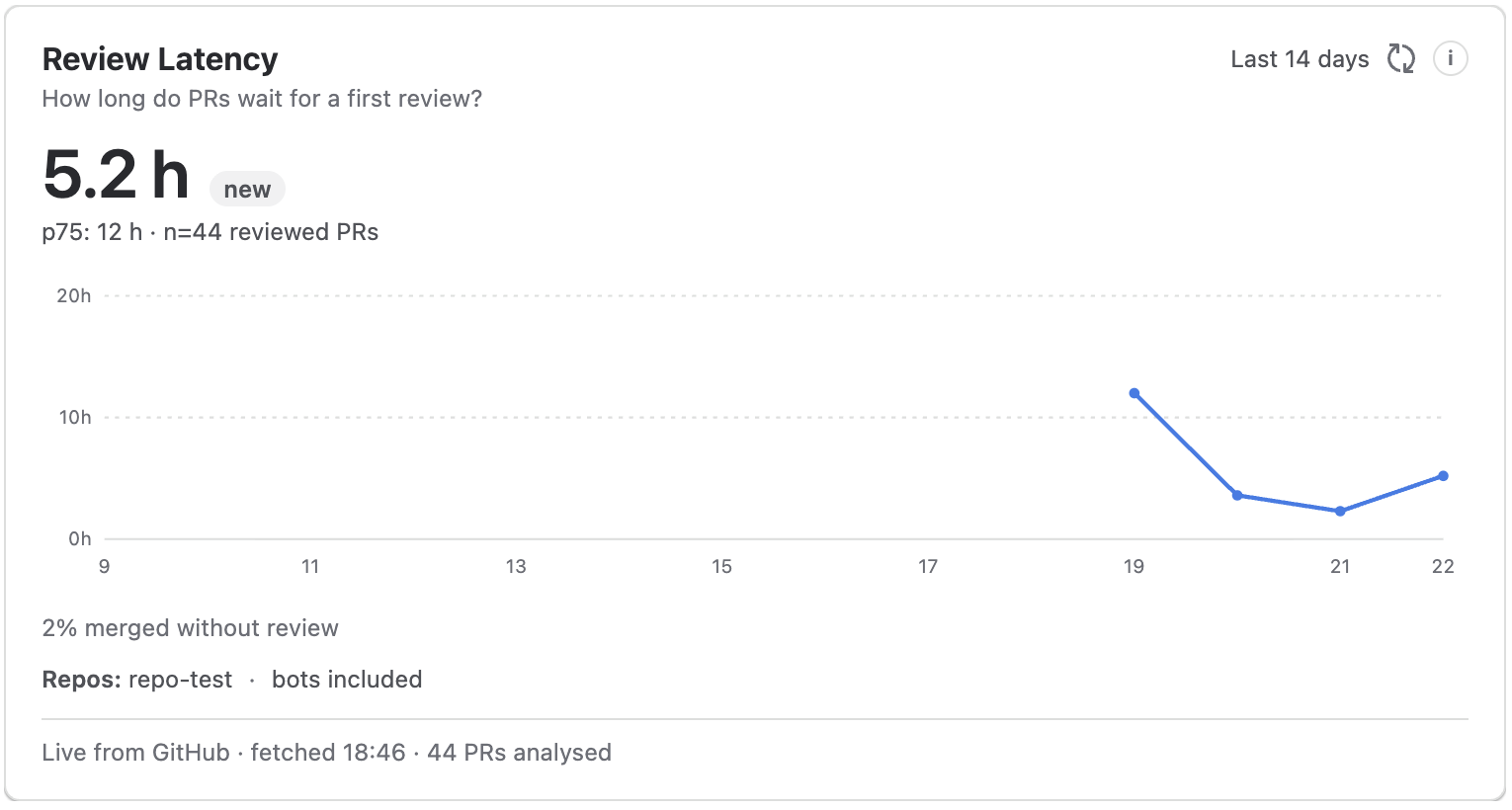
Full (KPI + chart) or Compact (KPI tile). 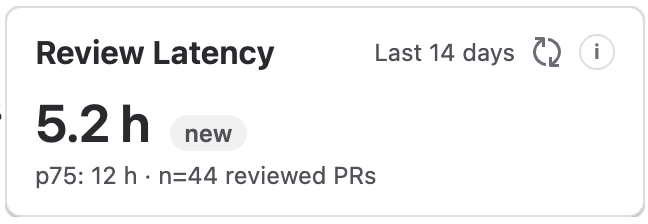
|
|
Compare to previous period |
Compare to the prior equivalent period. Enabled by default. |
|
Exclude bot / Dependabot PRs |
Filter out bot-authored PRs. Enabled by default. |
|
Title (optional) |
Custom heading. Defaults to Review Latency - {selected repositories}. |
What is measured
Review latency is the median time from a PR being ready for review to the first review comment or approval, across all merged PRs in the selected period that received at least one review.
The start point is readyForReviewAt if the PR has a recorded draft-to-ready transition, otherwise createdAt. PRs that received no review are excluded from the latency calculation but counted separately as an unreviewed % figure shown below the KPI.
The macro shows:
-
The median review latency for the selected period, plus the 75th percentile (p75) per chart bucket
-
A trend indicator vs. the previous period
-
The percentage of merged PRs that received no review
-
A trend chart over time (Full display only)
Reading the chart: Lower latency means PRs are getting attention faster. A rising trend can flag review-capacity issues - useful context when paired with Cycle Time. Metrics are team-level only - never per-developer.
Related pages
-
PR Cycle Time report - average time from PR opened to merged
-
PR Throughput report - how many PRs your team is merging over time
-
How metrics are calculated - full definitions and data sourcing detail
-
Preparing sprint retrospectives - using the reporting macros alongside PR and issue data
Updated: